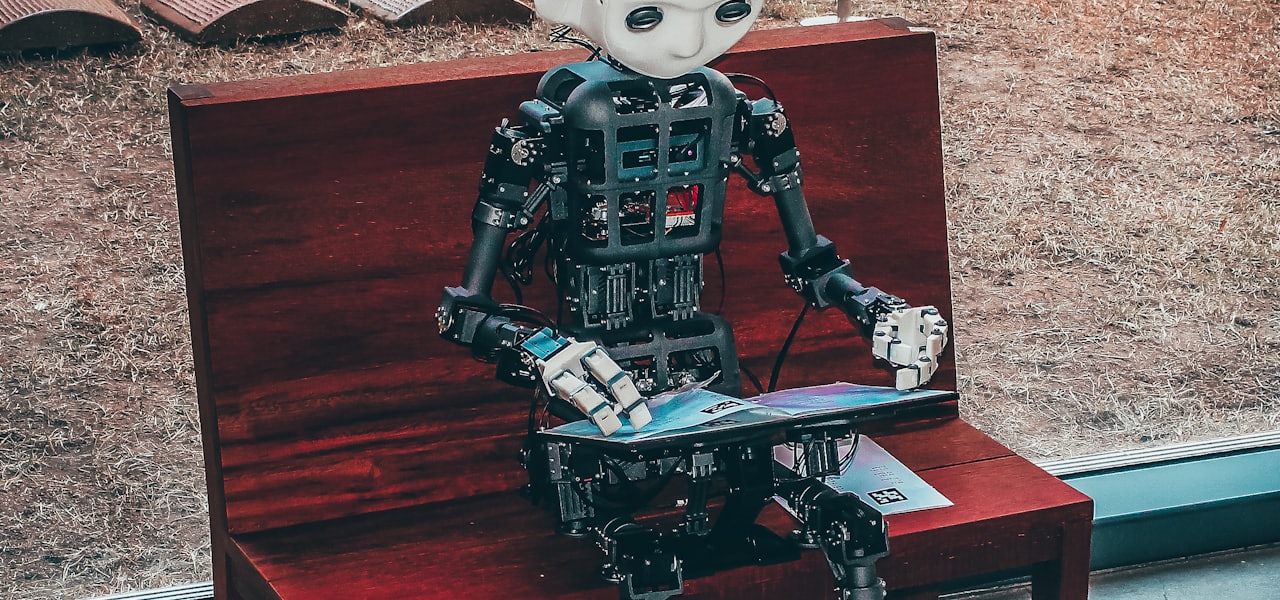
Comparing the best AI subtitle generator? An AI subtitle generator is software that uses machine learning to help you get more done — it lowers the barrier so anyone can produce professional output. Privacy matters too: check whether your data trains the model and whether a no-log or enterprise tier is available. Whether you are a beginner or a pro, the right AI subtitle generator slots into your workflow and pays for itself fast. We tested the leading options and ranked them by quality, value, and ease of use.
Python (programming language)
Python is a high-level, general-purpose programming language that emphasizes code readability, simplicity, and ease-of-writing with the use of significant indentation, "plain English" naming, an extensive ("batteries-included") standard library, and garbage collection. Python supports multiple programming paradigms but with an emphasis on object-oriented programming and dynamic typing. Guido van Rossum began working on Python in the late 1980s as a successor to the ABC programming language. Python 3.0, released in 2008, was a major revision and not completely backward-compatible with earlier versions. Beginning with Python 3.5, capabilities and keywords for typing were added to the language, allowing optional static typing. As of 2026, the Python Software Foundation supports Python 3.10, 3.11, 3.12, 3.13, and 3.14, following the project's annual release cycle and five-year support policy. Python 3.15 is currently in the alpha development phase, and the stable release is expected to launch in October 2026. Earlier versions in the 3.x series have reached end-of-life and no longer receive security updates. Python has gained extensive use in the machine learning community. It is widely taught as an introductory programming language. Since 2003, Python has consistently ranked among the top ten most popular programming languages in the TIOBE Programming Community Index, which ranks programming languages based on searches across 24 platforms. == History == Python was conceived in the late 1980s by Guido van Rossum at Centrum Wiskunde & Informatica (CWI) in the Netherlands. It was designed as a successor to the ABC programming language, which was inspired by SETL, capable of exception handling and interfacing with the Amoeba operating system. Python implementation began in December 1989. Van Rossum first released it in 1991 as Python 0.9.0. Van Rossum assumed sole responsibility for the project, as the lead developer, until 12 July 2018, when he announced his "permanent vacation" from responsibilities as Python's "benevolent dictator for life" (BDFL); this title was bestowed on him by the Python community to reflect his long-term commitment as the project's chief decision-maker. (He has since come out of retirement and is self-titled "BDFL-emeritus".) In January 2019, active Python core developers elected a five-member Steering Council to lead the project. The name Python derives from the British comedy series Monty Python's Flying Circus. (See § Naming.) Python 2.0 was released on 16 October 2000, featuring many new features such as list comprehensions, cycle-detecting garbage collection, reference counting, and Unicode support. Python 2.7's end-of-life was initially set for 2015, and then postponed to 2020 out of concern that a large body of existing code could not easily be forward-ported to Python 3. It no longer receives security patches or updates. While Python 2.7 and older versions are officially unsupported, a different unofficial Python implementation, PyPy, continues to support Python 2, i.e., "2.7.18+" (plus 3.11), with the plus signifying (at least some) "backported security updates". Python 3.0 was released on 3 December 2008, and was a major revision and not completely backward-compatible with earlier versions, with some new semantics and changed syntax. Python 2.7.18, released in 2020, was the last release of Python 2. Several releases in the Python 3.x series have added new syntax to the language, and made a few (considered very minor) backward-incompatible changes. As of May 2026, Python 3.14.5 is the latest stable release. All older 3.x versions had a security update down to Python 3.9.24 then again with 3.9.25, the final version in 3.9 series. Python 3.10 is, since November 2025, the oldest supported branch. Python 3.15 has an alpha released, and Android has an official downloadable executable available for Python 3.14. Releases receive two years of full support followed by three years of security support. == Design philosophy and features == Python is a multi-paradigm programming language. Object-oriented programming and structured programming are fully supported, and many of their features support functional programming and aspect-oriented programming – including metaprogramming and metaobjects. Many other paradigms are supported via extensions, including design by contract and logic programming. Python is often referred to as a 'glue language' because it is purposely designed to be able to integrate components written in other languages. Python uses dynamic typing and a combination of reference counting and a cycle-detecting garbage collector for memory management. It uses dynamic name resolution (late binding), which binds method and variable names during program execution. Python's design offers some support for functional programming in the "Lisp tradition". It has filter, map, and reduce functions; list comprehensions, dictionaries, sets, and generator expressions. The standard library has two modules (itertools and functools) that implement functional tools borrowed from Haskell and Standard ML. Python's core philosophy is summarized in the Zen of Python (PEP 20) written by Tim Peters, which includes aphorisms such as these: Explicit is better than implicit. Simple is better than complex. Readability counts. Special cases aren't special enough to break the rules. Although practicality beats purity, errors should never pass silently, unless explicitly silenced. There should be one-- and preferably only one --obvious way to do it. However, Python has received criticism for violating these principles and adding unnecessary language bloat. Responses to these criticisms note that the Zen of Python is a guideline rather than a rule. The addition of some new features had been controversial: Guido van Rossum resigned as Benevolent Dictator for Life after conflict about adding the assignment expression operator in Python 3.8. Nevertheless, rather than building all functionality into its core, Python was designed to be highly extensible through modules. This compact modularity has made it particularly popular as a means of adding programmable interfaces to existing applications. Van Rossum's vision of a small core language with a large standard library and an easily extensible interpreter stemmed from his frustrations with ABC, which represented the opposite approach. Python claims to strive for a simpler, less-cluttered syntax and grammar, while giving developers a choice in their coding methodology. Python lacks do .. while loops, which Rossum considered harmful. In contrast to Perl's motto "there is more than one way to do it", Python advocates an approach where "there should be one – and preferably only one – obvious way to do it". In practice, however, Python provides many ways to achieve a given goal. There are at least three ways to format a string literal, with no certainty as to which one a programmer should use. Alex Martelli is a Fellow at the Python Software Foundation and Python book author; he wrote that "To describe something as 'clever' is not considered a compliment in the Python culture." Python's developers typically prioritize readability over performance. For example, they reject patches to non-critical parts of the CPython reference implementation that would offer increases in speed that do not justify the cost of clarity and readability. Execution speed can be improved by moving speed-critical functions to extension modules written in languages such as C, or by using a just-in-time compiler like PyPy. Also, it is possible to transpile to other languages. However, this approach either fails to achieve the expected speed-up, since Python is a very dynamic language, or only a restricted subset of Python is compiled (with potential minor semantic changes). Python is meant to be a fun language to use. This goal is reflected in the name – a tribute to the British comedy group Monty Python – and in playful approaches to some tutorials and reference materials. For instance, some code examples use the terms "spam" and "eggs" (in reference to a Monty Python sketch), rather than the typical terms "foo" and "bar". A common neologism in the Python community is pythonic, which has a broad range of meanings related to program style: Pythonic code may use Python idioms well; be natural or show fluency in the language; or conform with Python's minimalist philosophy and emphasis on readability. === Enhancement Proposals === Python Enhancement Proposals are a design document for either providing information to the Python community, or proposal for new feature in Python. PEPs are intented to explain new processes in Python, provide naming conventions or document the processes in the language. PEPs are overseen by Python Steering Council. There are 3 kinds of PEPs, with those are being standards track PEP, Informational PEP and Process PEPs which has their own unique meanings. They were firstly introduced in 2000, in
Mountain car problem
Mountain Car, a standard testing domain in Reinforcement learning, is a problem in which an under-powered car must drive up a steep hill. Since gravity is stronger than the car's engine, even at full throttle, the car cannot simply accelerate up the steep slope. The car is situated in a valley and must learn to leverage potential energy by driving up the opposite hill before the car is able to make it to the goal at the top of the rightmost hill. The domain has been used as a test bed in various reinforcement learning papers. == Introduction == The mountain car problem, although fairly simple, is commonly applied because it requires a reinforcement learning agent to learn on two continuous variables: position and velocity. For any given state (position and velocity) of the car, the agent is given the possibility of driving left, driving right, or not using the engine at all. In the standard version of the problem, the agent receives a negative reward at every time step when the goal is not reached; the agent has no information about the goal until an initial success. == History == The mountain car problem appeared first in Andrew Moore's PhD thesis (1990). It was later more strictly defined in Singh and Sutton's reinforcement learning paper with eligibility traces. The problem became more widely studied when Sutton and Barto added it to their book Reinforcement Learning: An Introduction (1998). Throughout the years many versions of the problem have been used, such as those which modify the reward function, termination condition, and the start state. == Techniques used to solve mountain car == Q-learning and similar techniques for mapping discrete states to discrete actions need to be extended to be able to deal with the continuous state space of the problem. Approaches often fall into one of two categories, state space discretization or function approximation. === Discretization === In this approach, two continuous state variables are pushed into discrete states by bucketing each continuous variable into multiple discrete states. This approach works with properly tuned parameters but a disadvantage is information gathered from one state is not used to evaluate another state. Tile coding can be used to improve discretization and involves continuous variables mapping into sets of buckets offset from one another. Each step of training has a wider impact on the value function approximation because when the offset grids are summed, the information is diffused. === Function approximation === Function approximation is another way to solve the mountain car. By choosing a set of basis functions beforehand, or by generating them as the car drives, the agent can approximate the value function at each state. Unlike the step-wise version of the value function created with discretization, function approximation can more cleanly estimate the true smooth function of the mountain car domain. === Eligibility traces === One aspect of the problem involves the delay of actual reward. The agent is not able to learn about the goal until a successful completion. Given a naive approach for each trial the car can only backup the reward of the goal slightly. This is a problem for naive discretization because each discrete state will only be backed up once, taking a larger number of episodes to learn the problem. This problem can be alleviated via the mechanism of eligibility traces, which will automatically backup the reward given to states before, dramatically increasing the speed of learning. Eligibility traces can be viewed as a bridge from temporal difference learning methods to Monte Carlo methods. == Technical details == The mountain car problem has undergone many iterations. This section focuses on the standard well-defined version from Sutton (2008). === State variables === Two-dimensional continuous state space. V e l o c i t y = ( − 0.07 , 0.07 ) {\displaystyle Velocity=(-0.07,0.07)} P o s i t i o n = ( − 1.2 , 0.6 ) {\displaystyle Position=(-1.2,0.6)} === Actions === One-dimensional discrete action space. m o t o r = ( l e f t , n e u t r a l , r i g h t ) {\displaystyle motor=(left,neutral,right)} === Reward === For every time step: r e w a r d = − 1 {\displaystyle reward=-1} === Update function === For every time step: A c t i o n = [ − 1 , 0 , 1 ] {\displaystyle Action=[-1,0,1]} V e l o c i t y = V e l o c i t y + ( A c t i o n ) ∗ 0.001 + cos ( 3 ∗ P o s i t i o n ) ∗ ( − 0.0025 ) {\displaystyle Velocity=Velocity+(Action)0.001+\cos(3Position)(-0.0025)} P o s i t i o n = P o s i t i o n + V e l o c i t y {\displaystyle Position=Position+Velocity} === Starting condition === Optionally, many implementations include randomness in both parameters to show better generalized learning. P o s i t i o n = − 0.5 {\displaystyle Position=-0.5} V e l o c i t y = 0.0 {\displaystyle Velocity=0.0} === Termination condition === End the simulation when: P o s i t i o n ≥ 0.6 {\displaystyle Position\geq 0.6} == Variations == There are many versions of the mountain car which deviate in different ways from the standard model. Variables that vary include but are not limited to changing the constants (gravity and steepness) of the problem so specific tuning for specific policies become irrelevant and altering the reward function to affect the agent's ability to learn in a different manner. An example is changing the reward to be equal to the distance from the goal, or changing the reward to zero everywhere and one at the goal. Additionally, a 3D mountain car can be used, with a 4D continuous state space.
Automated machine learning
Automated machine learning (AutoML) is the process of automating the tasks of applying machine learning to real-world problems. It is the combination of automation and ML. AutoML potentially includes every stage from beginning with a raw dataset to building a machine learning model ready for deployment. AutoML was proposed as an artificial intelligence-based solution to the growing challenge of applying machine learning. The high degree of automation in AutoML aims to allow non-experts to make use of machine learning models and techniques without requiring them to become experts in machine learning. Automating the process of applying machine learning end-to-end additionally offers the advantages of producing simpler solutions, faster creation of those solutions, and models that often outperform hand-designed models. Common techniques used in AutoML include hyperparameter optimization, meta-learning and neural architecture search. == Comparison to the standard approach == In a typical machine learning application, practitioners have a set of input data points to be used for training. The raw data may not be in a form that all algorithms can be applied to. To make the data amenable for machine learning, an expert may have to apply appropriate data pre-processing, feature engineering, feature extraction, and feature selection methods. After these steps, practitioners must then perform algorithm selection and hyperparameter optimization to maximize the predictive performance of their model. If deep learning is used, the architecture of the neural network must also be chosen manually by the machine learning expert. Each of these steps may be challenging, resulting in significant hurdles to using machine learning. AutoML aims to simplify these steps for non-experts, and to make it easier for them to use machine learning techniques correctly and effectively. AutoML plays an important role within the broader approach of automating data science, which also includes challenging tasks such as data engineering, data exploration and model interpretation and prediction. == Targets of automation == Automated machine learning can target various stages of the machine learning process. Steps to automate are: Data preparation and ingestion (from raw data and miscellaneous formats) Column type detection; e.g., Boolean, discrete numerical, continuous numerical, or text Column intent detection; e.g., target/label, stratification field, numerical feature, categorical text feature, or free text feature Task detection; e.g., binary classification, regression, clustering, or ranking Feature engineering Feature selection Feature extraction Meta-learning and transfer learning Detection and handling of skewed data and/or missing values Model selection - choosing which machine learning algorithm to use, often including multiple competing software implementations Ensembling - a form of consensus where using multiple models often gives better results than any single model Hyperparameter optimization of the learning algorithm and featurization Neural architecture search Pipeline selection under time, memory, and complexity constraints Selection of evaluation metrics and validation procedures Problem checking Leakage detection Misconfiguration detection Analysis of obtained results Creating user interfaces and visualizations == Challenges and Limitations == There are a number of key challenges being tackled around automated machine learning. A big issue surrounding the field is referred to as "development as a cottage industry". This phrase refers to the issue in machine learning where development relies on manual decisions and biases of experts. This is contrasted to the goal of machine learning which is to create systems that can learn and improve from their own usage and analysis of the data. Basically, it's the struggle between how much experts should get involved in the learning of the systems versus how much freedom they should be giving the machines. However, experts and developers must help create and guide these machines to prepare them for their own learning. To create this system, it requires labor intensive work with knowledge of machine learning algorithms and system design. Additionally, other challenges include meta-learning and computational resource allocation.
Reparameterization trick
The reparameterization trick (aka "reparameterization gradient estimator") is a technique used in statistical machine learning, particularly in variational inference, variational autoencoders, and stochastic optimization. It allows for the efficient computation of gradients through random variables, enabling the optimization of parametric probability models using stochastic gradient descent, and the variance reduction of estimators. It was developed in the 1980s in operations research, under the name of "pathwise gradients", or "stochastic gradients". Its use in variational inference was proposed in 2013. == Mathematics == Let z {\displaystyle z} be a random variable with distribution q ϕ ( z ) {\displaystyle q_{\phi }(z)} , where ϕ {\displaystyle \phi } is a vector containing the parameters of the distribution. === REINFORCE estimator === Consider an objective function of the form: L ( ϕ ) = E z ∼ q ϕ ( z ) [ f ( z ) ] {\displaystyle L(\phi )=\mathbb {E} _{z\sim q_{\phi }(z)}[f(z)]} Without the reparameterization trick, estimating the gradient ∇ ϕ L ( ϕ ) {\displaystyle \nabla _{\phi }L(\phi )} can be challenging, because the parameter appears in the random variable itself. In more detail, we have to statistically estimate: ∇ ϕ L ( ϕ ) = ∇ ϕ ∫ d z q ϕ ( z ) f ( z ) {\displaystyle \nabla _{\phi }L(\phi )=\nabla _{\phi }\int dz\;q_{\phi }(z)f(z)} The REINFORCE estimator, widely used in reinforcement learning and especially policy gradient, uses the following equality: ∇ ϕ L ( ϕ ) = ∫ d z q ϕ ( z ) ∇ ϕ ( ln q ϕ ( z ) ) f ( z ) = E z ∼ q ϕ ( z ) [ ∇ ϕ ( ln q ϕ ( z ) ) f ( z ) ] {\displaystyle \nabla _{\phi }L(\phi )=\int dz\;q_{\phi }(z)\nabla _{\phi }(\ln q_{\phi }(z))f(z)=\mathbb {E} _{z\sim q_{\phi }(z)}[\nabla _{\phi }(\ln q_{\phi }(z))f(z)]} This allows the gradient to be estimated: ∇ ϕ L ( ϕ ) ≈ 1 N ∑ i = 1 N ∇ ϕ ( ln q ϕ ( z i ) ) f ( z i ) {\displaystyle \nabla _{\phi }L(\phi )\approx {\frac {1}{N}}\sum _{i=1}^{N}\nabla _{\phi }(\ln q_{\phi }(z_{i}))f(z_{i})} The REINFORCE estimator has high variance, and many methods were developed to reduce its variance. === Reparameterization estimator === The reparameterization trick expresses z {\displaystyle z} as: z = g ϕ ( ϵ ) , ϵ ∼ p ( ϵ ) {\displaystyle z=g_{\phi }(\epsilon ),\quad \epsilon \sim p(\epsilon )} Here, g ϕ {\displaystyle g_{\phi }} is a deterministic function parameterized by ϕ {\displaystyle \phi } , and ϵ {\displaystyle \epsilon } is a noise variable drawn from a fixed distribution p ( ϵ ) {\displaystyle p(\epsilon )} . This gives: L ( ϕ ) = E ϵ ∼ p ( ϵ ) [ f ( g ϕ ( ϵ ) ) ] {\displaystyle L(\phi )=\mathbb {E} _{\epsilon \sim p(\epsilon )}[f(g_{\phi }(\epsilon ))]} Now, the gradient can be estimated as: ∇ ϕ L ( ϕ ) = E ϵ ∼ p ( ϵ ) [ ∇ ϕ f ( g ϕ ( ϵ ) ) ] ≈ 1 N ∑ i = 1 N ∇ ϕ f ( g ϕ ( ϵ i ) ) {\displaystyle \nabla _{\phi }L(\phi )=\mathbb {E} _{\epsilon \sim p(\epsilon )}[\nabla _{\phi }f(g_{\phi }(\epsilon ))]\approx {\frac {1}{N}}\sum _{i=1}^{N}\nabla _{\phi }f(g_{\phi }(\epsilon _{i}))} == Examples == For some common distributions, the reparameterization trick takes specific forms: Normal distribution: For z ∼ N ( μ , σ 2 ) {\displaystyle z\sim {\mathcal {N}}(\mu ,\sigma ^{2})} , we can use: z = μ + σ ϵ , ϵ ∼ N ( 0 , 1 ) {\displaystyle z=\mu +\sigma \epsilon ,\quad \epsilon \sim {\mathcal {N}}(0,1)} Exponential distribution: For z ∼ Exp ( λ ) {\displaystyle z\sim {\text{Exp}}(\lambda )} , we can use: z = − 1 λ log ( ϵ ) , ϵ ∼ Uniform ( 0 , 1 ) {\displaystyle z=-{\frac {1}{\lambda }}\log(\epsilon ),\quad \epsilon \sim {\text{Uniform}}(0,1)} Discrete distribution can be reparameterized by the Gumbel distribution (Gumbel-softmax trick or "concrete distribution") and diffusion models. In general, any distribution that is differentiable with respect to its parameters can be reparameterized by inverting the multivariable CDF function, then apply the implicit method. See for an exposition and application to the Gamma, Beta, Dirichlet, and von Mises distributions. == Applications == === Variational autoencoder === In Variational Autoencoders (VAEs), the VAE objective function, known as the Evidence Lower Bound (ELBO), is given by: ELBO ( ϕ , θ ) = E z ∼ q ϕ ( z | x ) [ log p θ ( x | z ) ] − D KL ( q ϕ ( z | x ) | | p ( z ) ) {\displaystyle {\text{ELBO}}(\phi ,\theta )=\mathbb {E} _{z\sim q_{\phi }(z|x)}[\log p_{\theta }(x|z)]-D_{\text{KL}}(q_{\phi }(z|x)||p(z))} where q ϕ ( z | x ) {\displaystyle q_{\phi }(z|x)} is the encoder (recognition model), p θ ( x | z ) {\displaystyle p_{\theta }(x|z)} is the decoder (generative model), and p ( z ) {\displaystyle p(z)} is the prior distribution over latent variables. The gradient of ELBO with respect to θ {\displaystyle \theta } is simply E z ∼ q ϕ ( z | x ) [ ∇ θ log p θ ( x | z ) ] ≈ 1 L ∑ l = 1 L ∇ θ log p θ ( x | z l ) {\displaystyle \mathbb {E} _{z\sim q_{\phi }(z|x)}[\nabla _{\theta }\log p_{\theta }(x|z)]\approx {\frac {1}{L}}\sum _{l=1}^{L}\nabla _{\theta }\log p_{\theta }(x|z_{l})} but the gradient with respect to ϕ {\displaystyle \phi } requires the trick. Express the sampling operation z ∼ q ϕ ( z | x ) {\displaystyle z\sim q_{\phi }(z|x)} as: z = μ ϕ ( x ) + σ ϕ ( x ) ⊙ ϵ , ϵ ∼ N ( 0 , I ) {\displaystyle z=\mu _{\phi }(x)+\sigma _{\phi }(x)\odot \epsilon ,\quad \epsilon \sim {\mathcal {N}}(0,I)} where μ ϕ ( x ) {\displaystyle \mu _{\phi }(x)} and σ ϕ ( x ) {\displaystyle \sigma _{\phi }(x)} are the outputs of the encoder network, and ⊙ {\displaystyle \odot } denotes element-wise multiplication. Then we have ∇ ϕ ELBO ( ϕ , θ ) = E ϵ ∼ N ( 0 , I ) [ ∇ ϕ log p θ ( x | z ) + ∇ ϕ log q ϕ ( z | x ) − ∇ ϕ log p ( z ) ] {\displaystyle \nabla _{\phi }{\text{ELBO}}(\phi ,\theta )=\mathbb {E} _{\epsilon \sim {\mathcal {N}}(0,I)}[\nabla _{\phi }\log p_{\theta }(x|z)+\nabla _{\phi }\log q_{\phi }(z|x)-\nabla _{\phi }\log p(z)]} where z = μ ϕ ( x ) + σ ϕ ( x ) ⊙ ϵ {\displaystyle z=\mu _{\phi }(x)+\sigma _{\phi }(x)\odot \epsilon } . This allows us to estimate the gradient using Monte Carlo sampling: ∇ ϕ ELBO ( ϕ , θ ) ≈ 1 L ∑ l = 1 L [ ∇ ϕ log p θ ( x | z l ) + ∇ ϕ log q ϕ ( z l | x ) − ∇ ϕ log p ( z l ) ] {\displaystyle \nabla _{\phi }{\text{ELBO}}(\phi ,\theta )\approx {\frac {1}{L}}\sum _{l=1}^{L}[\nabla _{\phi }\log p_{\theta }(x|z_{l})+\nabla _{\phi }\log q_{\phi }(z_{l}|x)-\nabla _{\phi }\log p(z_{l})]} where z l = μ ϕ ( x ) + σ ϕ ( x ) ⊙ ϵ l {\displaystyle z_{l}=\mu _{\phi }(x)+\sigma _{\phi }(x)\odot \epsilon _{l}} and ϵ l ∼ N ( 0 , I ) {\displaystyle \epsilon _{l}\sim {\mathcal {N}}(0,I)} for l = 1 , … , L {\displaystyle l=1,\ldots ,L} . This formulation enables backpropagation through the sampling process, allowing for end-to-end training of the VAE model using stochastic gradient descent or its variants. === Variational inference === More generally, the trick allows using stochastic gradient descent for variational inference. Let the variational objective (ELBO) be of the form: ELBO ( ϕ ) = E z ∼ q ϕ ( z ) [ log p ( x , z ) − log q ϕ ( z ) ] {\displaystyle {\text{ELBO}}(\phi )=\mathbb {E} _{z\sim q_{\phi }(z)}[\log p(x,z)-\log q_{\phi }(z)]} Using the reparameterization trick, we can estimate the gradient of this objective with respect to ϕ {\displaystyle \phi } : ∇ ϕ ELBO ( ϕ ) ≈ 1 L ∑ l = 1 L ∇ ϕ [ log p ( x , g ϕ ( ϵ l ) ) − log q ϕ ( g ϕ ( ϵ l ) ) ] , ϵ l ∼ p ( ϵ ) {\displaystyle \nabla _{\phi }{\text{ELBO}}(\phi )\approx {\frac {1}{L}}\sum _{l=1}^{L}\nabla _{\phi }[\log p(x,g_{\phi }(\epsilon _{l}))-\log q_{\phi }(g_{\phi }(\epsilon _{l}))],\quad \epsilon _{l}\sim p(\epsilon )} === Dropout === The reparameterization trick has been applied to reduce the variance in dropout, a regularization technique in neural networks. The original dropout can be reparameterized with Bernoulli distributions: y = ( W ⊙ ϵ ) x , ϵ i j ∼ Bernoulli ( α i j ) {\displaystyle y=(W\odot \epsilon )x,\quad \epsilon _{ij}\sim {\text{Bernoulli}}(\alpha _{ij})} where W {\displaystyle W} is the weight matrix, x {\displaystyle x} is the input, and α i j {\displaystyle \alpha _{ij}} are the (fixed) dropout rates. More generally, other distributions can be used than the Bernoulli distribution, such as the gaussian noise: y i = μ i + σ i ⊙ ϵ i , ϵ i ∼ N ( 0 , I ) {\displaystyle y_{i}=\mu _{i}+\sigma _{i}\odot \epsilon _{i},\quad \epsilon _{i}\sim {\mathcal {N}}(0,I)} where μ i = m i ⊤ x {\displaystyle \mu _{i}=\mathbf {m} _{i}^{\top }x} and σ i 2 = v i ⊤ x 2 {\displaystyle \sigma _{i}^{2}=\mathbf {v} _{i}^{\top }x^{2}} , with m i {\displaystyle \mathbf {m} _{i}} and v i {\displaystyle \mathbf {v} _{i}} being the mean and variance of the i {\displaystyle i} -th output neuron. The reparameterization trick can be applied to all such cases, resulting in the variational dropout method.
Gitter
Gitter is an open-source instant messaging and chat room system for developers and users of GitLab and GitHub repositories. Gitter is provided as software as a service, with a free option providing all basic features and the ability to create a single private chat room, and paid subscription options for individuals and organisations, which allows them to create arbitrary numbers of private chat rooms. Individual chat rooms can be created for individual Git repositories on GitHub. Chatroom privacy follows the privacy settings of the associated GitHub repository: thus, a chatroom for a private (i.e. members-only) GitHub repository is also private to those with access to the repository. A graphical badge linking to the chat room can then be placed in the git repository's README file, bringing it to the attention of all users and developers of the project. Users can chat in the chat rooms, or access private chat rooms for repositories they have access to, by logging into Gitter via GitHub. Gitter is similar to Slack. Like Slack, it automatically logs all messages in the cloud. In late 2020, New Vector Limited acquired Gitter from GitLab, and announced Gitter's features would eventually be moved to New Vector's flagship product, Element, thereby replacing Gitter entirely. On February 13, 2023, Gitter migrated their service to a custom-branded Matrix instance that uses Element for its web interface. == Features prior to Migration to Matrix == Gitter supports: Notifications, which are batched up on mobile devices to avoid annoyance Inline media files Viewing and subscribing to ("starring") multiple chat rooms in one web browser tab Linking to individual files in the linked git repository Linking to GitHub issues (by typing # and then the issue number) in the linked Git repository, with hovercards showing the details of the issue GitHub-flavored Markdown in chat messages Online status for users User hovercards, based on their GitHub profiles and statistics (number of GitHub followers, etc.) Browsable and searchable message archives, grouped by month Connection from IRC clients Gitter on iOS support authentication using GitHub or Twitter === Integrations with non-GitHub sites and applications === Gitter integrates with Trello, Jenkins, Travis CI, Drone (software), Heroku, and Bitbucket, among others. === Apps === Official Gitter apps for Windows, Mac, Linux, iOS and Android are available. === Account registration === Like other chat technologies, Gitter allows clients to instant message each other. It allows people to authenticate using a GitHub account and join a chatroom from a web browser, thus not requiring one to install any software, or create additional online accounts. == History == Gitter was created by some developers who were initially trying to create a generic web-based chat product, but then wrote extra code to hook their chat application up to GitHub to meet their own needs, and realised that they could turn the combined product into a viable specialist product in its own right. Gitter came out of beta in 2014. During the beta period, Gitter delivered 1.8 million chat messages. On March 15, 2017, GitLab announced the acquisition of Gitter. Included in the announcement was the stated intent that Gitter would continue as a standalone project. It was published as open source under an MIT License as of June 2017. On September 30, 2020, New Vector Limited acquired Gitter from GitLab, and announced upcoming support for the Matrix protocol in Gitter, which went live by the end of the year. Gitter's features would eventually be moved to New Vector's flagship product, Element, thereby replacing Gitter entirely. On February 13, 2023, Gitter migrated their service to a custom-branded Matrix instance that uses Element for its web interface. == Implementation prior to Migration to Matrix == The Gitter web application is implemented entirely in JavaScript, with the back end being implemented on Node.js. The source code to the web application was formerly proprietary (it was open-sourced in June 2017), although Gitter had made numerous auxiliary projects available as open-source software, such as an IRC bridge for IRC users who prefer using IRC client applications (and their extra features) to converse in the Gitter chat rooms.
Learning curve (machine learning)
In machine learning (ML), a learning curve (or training curve) is a graphical representation that shows how a model's performance on a training set (and usually a validation set) changes with the number of training iterations (epochs) or the amount of training data. Typically, the number of training epochs or training set size is plotted on the x-axis, and the value of the loss function (and possibly some other metric such as the cross-validation score) on the y-axis. Synonyms include error curve, experience curve, improvement curve and generalization curve. More abstractly, learning curves plot the difference between learning effort and predictive performance, where "learning effort" usually means the number of training samples, and "predictive performance" means accuracy on testing samples. Learning curves have many useful purposes in ML, including: choosing model parameters during design, adjusting optimization to improve convergence, and diagnosing problems such as overfitting (or underfitting). Learning curves can also be tools for determining how much a model benefits from adding more training data, and whether the model suffers more from a variance error or a bias error. If both the validation score and the training score converge to a certain value, then the model will no longer significantly benefit from more training data. == Formal definition == When creating a function to approximate the distribution of some data, it is necessary to define a loss function L ( f θ ( X ) , Y ) {\displaystyle L(f_{\theta }(X),Y)} to measure how good the model output is (e.g., accuracy for classification tasks or mean squared error for regression). We then define an optimization process which finds model parameters θ {\displaystyle \theta } such that L ( f θ ( X ) , Y ) {\displaystyle L(f_{\theta }(X),Y)} is minimized, referred to as θ ∗ {\displaystyle \theta ^{}} . === Training curve for amount of data === If the training data is { x 1 , x 2 , … , x n } , { y 1 , y 2 , … y n } {\displaystyle \{x_{1},x_{2},\dots ,x_{n}\},\{y_{1},y_{2},\dots y_{n}\}} and the validation data is { x 1 ′ , x 2 ′ , … x m ′ } , { y 1 ′ , y 2 ′ , … y m ′ } {\displaystyle \{x_{1}',x_{2}',\dots x_{m}'\},\{y_{1}',y_{2}',\dots y_{m}'\}} , a learning curve is the plot of the two curves i ↦ L ( f θ ∗ ( X i , Y i ) ( X i ) , Y i ) {\displaystyle i\mapsto L(f_{\theta ^{}(X_{i},Y_{i})}(X_{i}),Y_{i})} i ↦ L ( f θ ∗ ( X i , Y i ) ( X i ′ ) , Y i ′ ) {\displaystyle i\mapsto L(f_{\theta ^{}(X_{i},Y_{i})}(X_{i}'),Y_{i}')} where X i = { x 1 , x 2 , … x i } {\displaystyle X_{i}=\{x_{1},x_{2},\dots x_{i}\}} === Training curve for number of iterations === Many optimization algorithms are iterative, repeating the same step (such as backpropagation) until the process converges to an optimal value. Gradient descent is one such algorithm. If θ i ∗ {\displaystyle \theta _{i}^{}} is the approximation of the optimal θ {\displaystyle \theta } after i {\displaystyle i} steps, a learning curve is the plot of i ↦ L ( f θ i ∗ ( X , Y ) ( X ) , Y ) {\displaystyle i\mapsto L(f_{\theta _{i}^{}(X,Y)}(X),Y)} i ↦ L ( f θ i ∗ ( X , Y ) ( X ′ ) , Y ′ ) {\displaystyle i\mapsto L(f_{\theta _{i}^{}(X,Y)}(X'),Y')}